Review


pcdna3 1 zeocin mammalian expression vector  (Thermo Fisher)


Bioz Verified Symbol Thermo Fisher is a verified supplier
Bioz Manufacturer Symbol Thermo Fisher manufactures this product  

  • Logo
  • About
  • News
  • Press Release
  • Team
  • Advisors
  • Partners
  • Contact
  • Bioz Stars
  • Bioz vStars
  • 99

    Structured Review

    Thermo Fisher pcdna3 1 zeocin mammalian expression vector
    Pcdna3 1 Zeocin Mammalian Expression Vector, supplied by Thermo Fisher, used in various techniques. Bioz Stars score: 99/100, based on 1 PubMed citations. ZERO BIAS - scores, article reviews, protocol conditions and more
    https://www.bioz.com/product/pcdna3+1+mammalian+expression+vector/Zeocin/pm24944734__ml4004759_si_001-158-11-15
    Average 99 stars, based on 1 article reviews
    pcdna3 1 zeocin mammalian expression vector - by Bioz Stars, 2026-09
    99/100 stars

    Images

    Related Articles

    Construct:

    Article Title: Two point mutations in protocadherin-1 disrupt hantavirus recognition and afford protection against lethal infection
    Article Snippet: .. Constructs encoding soluble (secreted) PCDH1 variants (sEC1-2 and sEC1-4) were generated by cloning the following sequences into the pcDNA3.1 mammalian expression vector (Thermo Fisher): EC1-EC2 (residues 1–284) or EC1-EC4 (residues 1–503), each in frame with a C-terminal GSG linker, followed by Myc, Flag, and deca-histidine tags. ..

    Article Title: Effects of Fc glycosylation on the activity of WNT mimetic agonistic antibodies
    Article Snippet: .. All constructs except immunoglobulin G-degrading enzyme of Streptococcus pyogenes (IdeS) were cloned into the pcDNA3.1(+) mammalian expression vector (Thermo Fisher Scientific Cat# V79020). ..

    Article Title: BRAIDing receptors for cell specific targeting
    Article Snippet: .. All constructs were cloned into pcDNA3.1(+) mammalian expression vector (Thermo Fisher). ..

    Generated:

    Article Title: Two point mutations in protocadherin-1 disrupt hantavirus recognition and afford protection against lethal infection
    Article Snippet: .. Constructs encoding soluble (secreted) PCDH1 variants (sEC1-2 and sEC1-4) were generated by cloning the following sequences into the pcDNA3.1 mammalian expression vector (Thermo Fisher): EC1-EC2 (residues 1–284) or EC1-EC4 (residues 1–503), each in frame with a C-terminal GSG linker, followed by Myc, Flag, and deca-histidine tags. ..

    Article Title: RAPSYN-Mediated Neddylation of BCR-ABL Alternatively Determines the Fate of Philadelphia Chromosome-positive Leukemia
    Article Snippet: After a 30 min reaction was run on an SDS-PAGE, silver-stained bands were excised and sent to Applied Protein Technology Co., Ltd. (Shanghai, China) for liquid chromatography-mass spectrometry (LC-MS/MS) analysis. .. Eukaryotic expression vectors encoding His-, GST-, HA-, Myc-, or Flag-tagged proteins were generated by inserting PCR-amplified fragments into the pcDNA3.1(+) mammalian expression vector (V79020, Invitrogen). .. Eukaryotic expression vectors encoding green fluorescent protein (GFP)-tagged proteins were generated by inserting PCR-amplified fragments into the pd1-EGFP-N1 vector (6073-1, Clontech).

    Cloning:

    Article Title: Two point mutations in protocadherin-1 disrupt hantavirus recognition and afford protection against lethal infection
    Article Snippet: .. Constructs encoding soluble (secreted) PCDH1 variants (sEC1-2 and sEC1-4) were generated by cloning the following sequences into the pcDNA3.1 mammalian expression vector (Thermo Fisher): EC1-EC2 (residues 1–284) or EC1-EC4 (residues 1–503), each in frame with a C-terminal GSG linker, followed by Myc, Flag, and deca-histidine tags. ..

    Expressing:

    Article Title: Two point mutations in protocadherin-1 disrupt hantavirus recognition and afford protection against lethal infection
    Article Snippet: .. Constructs encoding soluble (secreted) PCDH1 variants (sEC1-2 and sEC1-4) were generated by cloning the following sequences into the pcDNA3.1 mammalian expression vector (Thermo Fisher): EC1-EC2 (residues 1–284) or EC1-EC4 (residues 1–503), each in frame with a C-terminal GSG linker, followed by Myc, Flag, and deca-histidine tags. ..

    Article Title: Role of the human solute carrier family 14 member 1 gene in hypoxia-induced renal cell carcinoma occurrence and its enlightenment to cancer nursing.
    Article Snippet: .. SLC14A1 cDNA was subcloned into a pcDNA3.1 mammalian expression vector (CAT#: V79520, Invitrogen Life Technologies, Carlsbad, CA, USA). ..

    Article Title: Mechanism of an RBM-targeted rabbit monoclonal antibody 9H1 neutralizing SARS-CoV-2.
    Article Snippet: .. In brief, the genes encoding residues 1e1208 of WT and Delta spike ECD were cloned into the pcDNA3.1 mammalian expression vector (Invitrogen) and transfected into FreeStyle 293-F cells (Invitrogen) using polyethyleneimine (PEI, Polysciences). .. Spike proteins were purified using Ni Sepharose resin (Cytiva) and further purified through gel filtration chromatography using a Superose 6 10/300 column (Cytiva) in 1 TBS (20 mM TrisHCl, 200 mM NaCl, pH 8.0).

    Article Title: Effects of Fc glycosylation on the activity of WNT mimetic agonistic antibodies
    Article Snippet: .. All constructs except immunoglobulin G-degrading enzyme of Streptococcus pyogenes (IdeS) were cloned into the pcDNA3.1(+) mammalian expression vector (Thermo Fisher Scientific Cat# V79020). ..

    Article Title: BRAIDing receptors for cell specific targeting
    Article Snippet: .. All constructs were cloned into pcDNA3.1(+) mammalian expression vector (Thermo Fisher). ..

    Article Title: Enhanced antitumor activity of a novel, oral, helper epitope-containing WT1 protein vaccine in a model of murine leukemia.
    Article Snippet: .. To prepare C1498-murine WT1 (C1498-mWT1), a murine leukemia cell line C1498 purchased from ATCC (Rockville, MD) was genetically transduced with CMV promotor-driven murine WT1 17AA(+) KTS(+) isoform full-length cDNA that had been inserted into the pcDNA3.1(+) mammalian expression vector (Invitrogen, Tokyo, Japan). ..

    Article Title: RAPSYN-Mediated Neddylation of BCR-ABL Alternatively Determines the Fate of Philadelphia Chromosome-positive Leukemia
    Article Snippet: After a 30 min reaction was run on an SDS-PAGE, silver-stained bands were excised and sent to Applied Protein Technology Co., Ltd. (Shanghai, China) for liquid chromatography-mass spectrometry (LC-MS/MS) analysis. .. Eukaryotic expression vectors encoding His-, GST-, HA-, Myc-, or Flag-tagged proteins were generated by inserting PCR-amplified fragments into the pcDNA3.1(+) mammalian expression vector (V79020, Invitrogen). .. Eukaryotic expression vectors encoding green fluorescent protein (GFP)-tagged proteins were generated by inserting PCR-amplified fragments into the pd1-EGFP-N1 vector (6073-1, Clontech).

    Plasmid Preparation:

    Article Title: Two point mutations in protocadherin-1 disrupt hantavirus recognition and afford protection against lethal infection
    Article Snippet: .. Constructs encoding soluble (secreted) PCDH1 variants (sEC1-2 and sEC1-4) were generated by cloning the following sequences into the pcDNA3.1 mammalian expression vector (Thermo Fisher): EC1-EC2 (residues 1–284) or EC1-EC4 (residues 1–503), each in frame with a C-terminal GSG linker, followed by Myc, Flag, and deca-histidine tags. ..

    Article Title: Role of the human solute carrier family 14 member 1 gene in hypoxia-induced renal cell carcinoma occurrence and its enlightenment to cancer nursing.
    Article Snippet: .. SLC14A1 cDNA was subcloned into a pcDNA3.1 mammalian expression vector (CAT#: V79520, Invitrogen Life Technologies, Carlsbad, CA, USA). ..

    Article Title: Mechanism of an RBM-targeted rabbit monoclonal antibody 9H1 neutralizing SARS-CoV-2.
    Article Snippet: .. In brief, the genes encoding residues 1e1208 of WT and Delta spike ECD were cloned into the pcDNA3.1 mammalian expression vector (Invitrogen) and transfected into FreeStyle 293-F cells (Invitrogen) using polyethyleneimine (PEI, Polysciences). .. Spike proteins were purified using Ni Sepharose resin (Cytiva) and further purified through gel filtration chromatography using a Superose 6 10/300 column (Cytiva) in 1 TBS (20 mM TrisHCl, 200 mM NaCl, pH 8.0).

    Article Title: BRAIDing receptors for cell specific targeting
    Article Snippet: .. All constructs were cloned into pcDNA3.1(+) mammalian expression vector (Thermo Fisher). ..

    Article Title: RAPSYN-Mediated Neddylation of BCR-ABL Alternatively Determines the Fate of Philadelphia Chromosome-positive Leukemia
    Article Snippet: After a 30 min reaction was run on an SDS-PAGE, silver-stained bands were excised and sent to Applied Protein Technology Co., Ltd. (Shanghai, China) for liquid chromatography-mass spectrometry (LC-MS/MS) analysis. .. Eukaryotic expression vectors encoding His-, GST-, HA-, Myc-, or Flag-tagged proteins were generated by inserting PCR-amplified fragments into the pcDNA3.1(+) mammalian expression vector (V79020, Invitrogen). .. Eukaryotic expression vectors encoding green fluorescent protein (GFP)-tagged proteins were generated by inserting PCR-amplified fragments into the pd1-EGFP-N1 vector (6073-1, Clontech).

    Clone Assay:

    Article Title: Mechanism of an RBM-targeted rabbit monoclonal antibody 9H1 neutralizing SARS-CoV-2.
    Article Snippet: .. In brief, the genes encoding residues 1e1208 of WT and Delta spike ECD were cloned into the pcDNA3.1 mammalian expression vector (Invitrogen) and transfected into FreeStyle 293-F cells (Invitrogen) using polyethyleneimine (PEI, Polysciences). .. Spike proteins were purified using Ni Sepharose resin (Cytiva) and further purified through gel filtration chromatography using a Superose 6 10/300 column (Cytiva) in 1 TBS (20 mM TrisHCl, 200 mM NaCl, pH 8.0).

    Article Title: Effects of Fc glycosylation on the activity of WNT mimetic agonistic antibodies
    Article Snippet: .. All constructs except immunoglobulin G-degrading enzyme of Streptococcus pyogenes (IdeS) were cloned into the pcDNA3.1(+) mammalian expression vector (Thermo Fisher Scientific Cat# V79020). ..

    Article Title: BRAIDing receptors for cell specific targeting
    Article Snippet: .. All constructs were cloned into pcDNA3.1(+) mammalian expression vector (Thermo Fisher). ..

    Transfection:

    Article Title: Mechanism of an RBM-targeted rabbit monoclonal antibody 9H1 neutralizing SARS-CoV-2.
    Article Snippet: .. In brief, the genes encoding residues 1e1208 of WT and Delta spike ECD were cloned into the pcDNA3.1 mammalian expression vector (Invitrogen) and transfected into FreeStyle 293-F cells (Invitrogen) using polyethyleneimine (PEI, Polysciences). .. Spike proteins were purified using Ni Sepharose resin (Cytiva) and further purified through gel filtration chromatography using a Superose 6 10/300 column (Cytiva) in 1 TBS (20 mM TrisHCl, 200 mM NaCl, pH 8.0).

    Transduction:

    Article Title: Enhanced antitumor activity of a novel, oral, helper epitope-containing WT1 protein vaccine in a model of murine leukemia.
    Article Snippet: .. To prepare C1498-murine WT1 (C1498-mWT1), a murine leukemia cell line C1498 purchased from ATCC (Rockville, MD) was genetically transduced with CMV promotor-driven murine WT1 17AA(+) KTS(+) isoform full-length cDNA that had been inserted into the pcDNA3.1(+) mammalian expression vector (Invitrogen, Tokyo, Japan). ..

    Polymerase Chain Reaction:

    Article Title: RAPSYN-Mediated Neddylation of BCR-ABL Alternatively Determines the Fate of Philadelphia Chromosome-positive Leukemia
    Article Snippet: After a 30 min reaction was run on an SDS-PAGE, silver-stained bands were excised and sent to Applied Protein Technology Co., Ltd. (Shanghai, China) for liquid chromatography-mass spectrometry (LC-MS/MS) analysis. .. Eukaryotic expression vectors encoding His-, GST-, HA-, Myc-, or Flag-tagged proteins were generated by inserting PCR-amplified fragments into the pcDNA3.1(+) mammalian expression vector (V79020, Invitrogen). .. Eukaryotic expression vectors encoding green fluorescent protein (GFP)-tagged proteins were generated by inserting PCR-amplified fragments into the pd1-EGFP-N1 vector (6073-1, Clontech).

    other:

    Article Title: Activatable antibodies that bind epidermal growth factor receptor and methods thereof
    Article Snippet: The activatable anti-EGFR antibodies were purified using a HiTrap Mab Select Sure protein A column (GE Healthcare) coupled to an AKTA purifier (GE Healthcare).


    Similar Products

    99
    Thermo Fisher pcdna3 1 zeocin mammalian expression vector
    Pcdna3 1 Zeocin Mammalian Expression Vector, supplied by Thermo Fisher, used in various techniques. Bioz Stars score: 99/100, based on 1 PubMed citations. ZERO BIAS - scores, article reviews, protocol conditions and more
    https://www.bioz.com/product/pcdna3+1+mammalian+expression+vector/Zeocin/pm24944734__ml4004759_si_001-158-11-15
    Average 99 stars, based on 1 article reviews
    pcdna3 1 zeocin mammalian expression vector - by Bioz Stars, 2026-09
    99/100 stars
      Buy from Supplier

    99
    Thermo Fisher pcdna3 1 amp mammalian expression vector
    Pcdna3 1 Amp Mammalian Expression Vector, supplied by Thermo Fisher, used in various techniques. Bioz Stars score: 99/100, based on 1 PubMed citations. ZERO BIAS - scores, article reviews, protocol conditions and more
    https://www.bioz.com/product/pcdna3+1+mammalian+expression+vector/Ampicillin+trihydrate/pm41015326-99-5-10
    Average 99 stars, based on 1 article reviews
    pcdna3 1 amp mammalian expression vector - by Bioz Stars, 2026-09
    99/100 stars
      Buy from Supplier

    93
    Addgene inc mammalian expression vector pcdna3 1
    Mammalian Expression Vector Pcdna3 1, supplied by Addgene inc, used in various techniques. Bioz Stars score: 93/100, based on 1 PubMed citations. ZERO BIAS - scores, article reviews, protocol conditions and more
    https://www.bioz.com/product/pcdna3+1+mammalian+expression+vector/GtCCR2_EYFP_pcDNA3%2E1+(Plasmid+%23159121)/pm40721511-242-22-30
    Average 93 stars, based on 1 article reviews
    mammalian expression vector pcdna3 1 - by Bioz Stars, 2026-09
    93/100 stars
      Buy from Supplier

    93
    Addgene inc mammalian expression vector pires cyofp1
    Averaged whole cell current traces from cells expressing KCNE1 variants in the homozygous state. Each trace represents JNJ-303 sensitive currents from an average of 21-126 cells co-expressing <t>KCNQ1</t> with the indicated KCNE1 variant. Currents were normalized to peak current in cells expressing WT KCNE1 and WT KCNQ1 recorded in parallel. Scale bars represent 25% of WT (vertical) and 500 ms (horizontal). Location of variants is indicated by the colored labels (green = N-terminus; orange = TM domain; blue = C-terminus).
    Mammalian Expression Vector Pires Cyofp1, supplied by Addgene inc, used in various techniques. Bioz Stars score: 93/100, based on 1 PubMed citations. ZERO BIAS - scores, article reviews, protocol conditions and more
    https://www.bioz.com/product/pcdna3+1+mammalian+expression+vector/NHR1%2B2-Flag+pcDNA3%2E1+(Plasmid+%2317316)/bio_rxiv__2025__03__28__646046-36-15-20
    Average 93 stars, based on 1 article reviews
    mammalian expression vector pires cyofp1 - by Bioz Stars, 2026-09
    93/100 stars
      Buy from Supplier

    96
    Addgene inc pcdna3 1 mammalian expression vector
    Averaged whole cell current traces from cells expressing KCNE1 variants in the homozygous state. Each trace represents JNJ-303 sensitive currents from an average of 21-126 cells co-expressing <t>KCNQ1</t> with the indicated KCNE1 variant. Currents were normalized to peak current in cells expressing WT KCNE1 and WT KCNQ1 recorded in parallel. Scale bars represent 25% of WT (vertical) and 500 ms (horizontal). Location of variants is indicated by the colored labels (green = N-terminus; orange = TM domain; blue = C-terminus).
    Pcdna3 1 Mammalian Expression Vector, supplied by Addgene inc, used in various techniques. Bioz Stars score: 96/100, based on 1 PubMed citations. ZERO BIAS - scores, article reviews, protocol conditions and more
    https://www.bioz.com/product/pcdna3+1+mammalian+expression+vector/pcDNA3%2E1(%2B)+Laccase2+MCS+Exon+Vector+(Plasmid+%2369893)/pm39798888-65-8-16
    Average 96 stars, based on 1 article reviews
    pcdna3 1 mammalian expression vector - by Bioz Stars, 2026-09
    96/100 stars
      Buy from Supplier

    99
    New England Biolabs mammalian expression vector pcdna3 1
    Averaged whole cell current traces from cells expressing KCNE1 variants in the homozygous state. Each trace represents JNJ-303 sensitive currents from an average of 21-126 cells co-expressing <t>KCNQ1</t> with the indicated KCNE1 variant. Currents were normalized to peak current in cells expressing WT KCNE1 and WT KCNQ1 recorded in parallel. Scale bars represent 25% of WT (vertical) and 500 ms (horizontal). Location of variants is indicated by the colored labels (green = N-terminus; orange = TM domain; blue = C-terminus).
    Mammalian Expression Vector Pcdna3 1, supplied by New England Biolabs, used in various techniques. Bioz Stars score: 99/100, based on 1 PubMed citations. ZERO BIAS - scores, article reviews, protocol conditions and more
    https://www.bioz.com/product/pcdna3+1+mammalian+expression+vector/Gibson+Assembly+Master+Mix/pmc11283548-203-15-24
    Average 99 stars, based on 1 article reviews
    mammalian expression vector pcdna3 1 - by Bioz Stars, 2026-09
    99/100 stars
      Buy from Supplier

    95
    OriGene pcdna3 1 pdna mammalian expression plasmid
    Averaged whole cell current traces from cells expressing KCNE1 variants in the homozygous state. Each trace represents JNJ-303 sensitive currents from an average of 21-126 cells co-expressing <t>KCNQ1</t> with the indicated KCNE1 variant. Currents were normalized to peak current in cells expressing WT KCNE1 and WT KCNQ1 recorded in parallel. Scale bars represent 25% of WT (vertical) and 500 ms (horizontal). Location of variants is indicated by the colored labels (green = N-terminus; orange = TM domain; blue = C-terminus).
    Pcdna3 1 Pdna Mammalian Expression Plasmid, supplied by OriGene, used in various techniques. Bioz Stars score: 95/100, based on 1 PubMed citations. ZERO BIAS - scores, article reviews, protocol conditions and more
    https://www.bioz.com/product/pcdna3+1+mammalian+expression+vector/pCMV6-AC+Mammalian+Expression+Vector/pmc11062983-97-18-27
    Average 95 stars, based on 1 article reviews
    pcdna3 1 pdna mammalian expression plasmid - by Bioz Stars, 2026-09
    95/100 stars
      Buy from Supplier

    Image Search Results


    Averaged whole cell current traces from cells expressing KCNE1 variants in the homozygous state. Each trace represents JNJ-303 sensitive currents from an average of 21-126 cells co-expressing KCNQ1 with the indicated KCNE1 variant. Currents were normalized to peak current in cells expressing WT KCNE1 and WT KCNQ1 recorded in parallel. Scale bars represent 25% of WT (vertical) and 500 ms (horizontal). Location of variants is indicated by the colored labels (green = N-terminus; orange = TM domain; blue = C-terminus).

    Journal: bioRxiv

    Article Title: Functional profiling of KCNE1 variants informs population carrier frequency of Jervell and Lange-Nielsen syndrome type 2

    doi: 10.1101/2025.03.28.646046

    Figure Lengend Snippet: Averaged whole cell current traces from cells expressing KCNE1 variants in the homozygous state. Each trace represents JNJ-303 sensitive currents from an average of 21-126 cells co-expressing KCNQ1 with the indicated KCNE1 variant. Currents were normalized to peak current in cells expressing WT KCNE1 and WT KCNQ1 recorded in parallel. Scale bars represent 25% of WT (vertical) and 500 ms (horizontal). Location of variants is indicated by the colored labels (green = N-terminus; orange = TM domain; blue = C-terminus).

    Article Snippet: Full length cDNA encoding WT KCNQ1 (GenBank accession number AF000571 ) was engineered in the mammalian expression vector pIRES-CyOFP1 (pIRES-CyOFP1-KCNQ1, AddGene #173162).

    Techniques: Expressing, Variant Assay

    Peak current density for KCNE1 variants in the homozygous state. JNJ-303 sensitive peak whole-cell currents measured at +60 mV from CHO-K1 cells co-expressing WT KCNQ1 with KCNE1 variants plotted as fold difference from WT channels recorded in parallel. ( A ) Variants in the N-terminus (green symbols). ( B ) Variants in the transmembrane domain (orange symbols). ( C ) Variants in the C-terminus (blue symbols). All individual data points are plotted as open symbols and mean values are shown as filled symbols with error bars representing the 95% CI. Values to the right or left of the vertical dashed line (normalized WT value) represent current density larger (gain-of-function) or smaller (loss-of-function) than WT, respectively. The number of recorded cells for each variant and individual P -values are presented in Supplemental Dataset 1 .

    Journal: bioRxiv

    Article Title: Functional profiling of KCNE1 variants informs population carrier frequency of Jervell and Lange-Nielsen syndrome type 2

    doi: 10.1101/2025.03.28.646046

    Figure Lengend Snippet: Peak current density for KCNE1 variants in the homozygous state. JNJ-303 sensitive peak whole-cell currents measured at +60 mV from CHO-K1 cells co-expressing WT KCNQ1 with KCNE1 variants plotted as fold difference from WT channels recorded in parallel. ( A ) Variants in the N-terminus (green symbols). ( B ) Variants in the transmembrane domain (orange symbols). ( C ) Variants in the C-terminus (blue symbols). All individual data points are plotted as open symbols and mean values are shown as filled symbols with error bars representing the 95% CI. Values to the right or left of the vertical dashed line (normalized WT value) represent current density larger (gain-of-function) or smaller (loss-of-function) than WT, respectively. The number of recorded cells for each variant and individual P -values are presented in Supplemental Dataset 1 .

    Article Snippet: Full length cDNA encoding WT KCNQ1 (GenBank accession number AF000571 ) was engineered in the mammalian expression vector pIRES-CyOFP1 (pIRES-CyOFP1-KCNQ1, AddGene #173162).

    Techniques: Expressing, Variant Assay

    Averaged whole cell current traces from cells expressing KCNE1 variants in the heterozygous state. Each trace represents JNJ-303 sensitive currents from an average of 38-131 CHO-E1 cells coexpressing KCNQ1 with the indicated KCNE1 variant. Currents were normalized to peak current in CHO-E1 cells co-expressing WT KCNE1 and WT KCNQ1 recorded in parallel. Scale bars represent 25% of WT (vertical) and 500 ms (horizontal). Location of variants is indicated by the colored labels (green = N-terminus; orange = TM domain; blue = C-terminus).

    Journal: bioRxiv

    Article Title: Functional profiling of KCNE1 variants informs population carrier frequency of Jervell and Lange-Nielsen syndrome type 2

    doi: 10.1101/2025.03.28.646046

    Figure Lengend Snippet: Averaged whole cell current traces from cells expressing KCNE1 variants in the heterozygous state. Each trace represents JNJ-303 sensitive currents from an average of 38-131 CHO-E1 cells coexpressing KCNQ1 with the indicated KCNE1 variant. Currents were normalized to peak current in CHO-E1 cells co-expressing WT KCNE1 and WT KCNQ1 recorded in parallel. Scale bars represent 25% of WT (vertical) and 500 ms (horizontal). Location of variants is indicated by the colored labels (green = N-terminus; orange = TM domain; blue = C-terminus).

    Article Snippet: Full length cDNA encoding WT KCNQ1 (GenBank accession number AF000571 ) was engineered in the mammalian expression vector pIRES-CyOFP1 (pIRES-CyOFP1-KCNQ1, AddGene #173162).

    Techniques: Expressing, Variant Assay

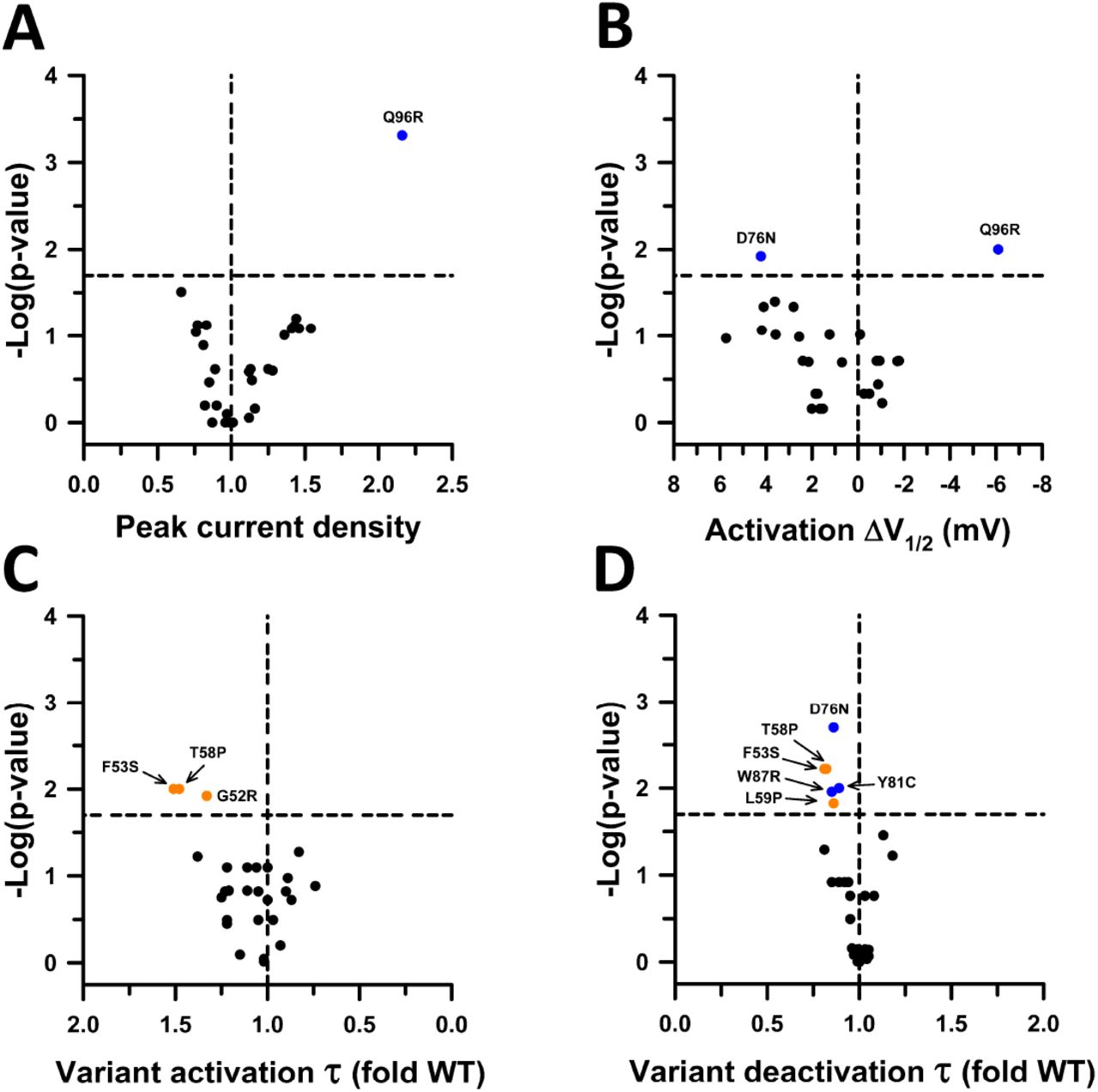
    Functional properties of KCNE1 variants in the heterozygous state. ( A ) Volcano plots of mean JNJ-303 sensitive peak whole-cell current density measured at +60 mV from CHO-E1 cells co-expressing WT KCNQ1 with each KCNE1 variant. Data are displayed as fold divergence from WT channels recorded in parallel. Only variants with peak current density significantly different from WT ( P < 0.02, horizontal dashed line) are labeled. Values to the right or left of the vertical dashed line (normalized WT value) represent current density larger or smaller than WT, respectively. ( B ) Volcano plots of mean difference (ΔV½ in mV) between the averaged V½ for variant and WT channels recorded in parallel. Only variants with peak current density significantly different from WT (P<0.02, horizontal dashed line) are labeled. Values to the right or left of the vertical dashed line indicate hyperpolarized or depolarized activation V½, respectively. ( C ) Volcano plots of mean activation time constants (τ) determined for each heterozygous KCNE1 variant plotted as the ratio to the averaged activation time constant for WT channels recorded in parallel. Values to the right or left of the vertical dashed line (no difference from WT) indicate faster or slower activation, respectively. ( D ) Volcano plots of mean deactivation time constants (τ) determined for each heterozygous KCNE1 variant plotted as the ratio to the averaged deactivation time constant for WT channels recorded in parallel. Values to the right or left of the vertical dashed line indicate slower or faster deactivation, respectively. Symbols colors are defined in previous figures. The number of recorded cells for each variant and individual P -values are presented in Supplemental Dataset 2 . Scatter plots of individual data are presented in Supplemental Figure S8 .

    Journal: bioRxiv

    Article Title: Functional profiling of KCNE1 variants informs population carrier frequency of Jervell and Lange-Nielsen syndrome type 2

    doi: 10.1101/2025.03.28.646046

    Figure Lengend Snippet: Functional properties of KCNE1 variants in the heterozygous state. ( A ) Volcano plots of mean JNJ-303 sensitive peak whole-cell current density measured at +60 mV from CHO-E1 cells co-expressing WT KCNQ1 with each KCNE1 variant. Data are displayed as fold divergence from WT channels recorded in parallel. Only variants with peak current density significantly different from WT ( P < 0.02, horizontal dashed line) are labeled. Values to the right or left of the vertical dashed line (normalized WT value) represent current density larger or smaller than WT, respectively. ( B ) Volcano plots of mean difference (ΔV½ in mV) between the averaged V½ for variant and WT channels recorded in parallel. Only variants with peak current density significantly different from WT (P<0.02, horizontal dashed line) are labeled. Values to the right or left of the vertical dashed line indicate hyperpolarized or depolarized activation V½, respectively. ( C ) Volcano plots of mean activation time constants (τ) determined for each heterozygous KCNE1 variant plotted as the ratio to the averaged activation time constant for WT channels recorded in parallel. Values to the right or left of the vertical dashed line (no difference from WT) indicate faster or slower activation, respectively. ( D ) Volcano plots of mean deactivation time constants (τ) determined for each heterozygous KCNE1 variant plotted as the ratio to the averaged deactivation time constant for WT channels recorded in parallel. Values to the right or left of the vertical dashed line indicate slower or faster deactivation, respectively. Symbols colors are defined in previous figures. The number of recorded cells for each variant and individual P -values are presented in Supplemental Dataset 2 . Scatter plots of individual data are presented in Supplemental Figure S8 .

    Article Snippet: Full length cDNA encoding WT KCNQ1 (GenBank accession number AF000571 ) was engineered in the mammalian expression vector pIRES-CyOFP1 (pIRES-CyOFP1-KCNQ1, AddGene #173162).

    Techniques: Functional Assay, Expressing, Variant Assay, Labeling, Activation Assay

    Functional properties of KCNE1 variants in the heterozygous state. ( A ) Average JNJ-303-sensitive peak whole-cell current density measured at +60 mV from CHO-E1 cells co-expressing WT KCNQ1 with each KCNE1 variant. Data are displayed as fold divergence from WT channels recorded in parallel. Values to the right or left of the vertical dashed line (normalized WT value) represent current density larger or smaller than WT, respectively. ( B ) Activation voltage-dependence for each heterozygous KCNE1 variant plotted as the difference (ΔV½ in mV) between the averaged V½ for WT channels recorded in parallel. Values to the right or left of the vertical dashed line indicate hyperpolarized or depolarized activation V½, respectively. ( C ) Activation time constants (τ) determined for each heterozygous KCNE1 variant plotted as the ratio to the averaged activation time constant for WT channels recorded in parallel. Values to the right or left of the vertical dashed line (no difference from WT) indicate faster or slower activation, respectively. ( D ) Deactivation time constants (τ) determined for each heterozygous KCNE1 variant plotted as the ratio to the averaged deactivation time constant for WT channels recorded in parallel. Values to the right or left of the vertical dashed line indicate slower or faster deactivation, respectively. Location of variants is indicated by the colored symbols (green = N-terminus; orange = TM domain; blue = C-terminus). The number of recorded cells for each variant and individual P -values are presented in Dataset 2 .

    Journal: bioRxiv

    Article Title: Functional profiling of KCNE1 variants informs population carrier frequency of Jervell and Lange-Nielsen syndrome type 2

    doi: 10.1101/2025.03.28.646046

    Figure Lengend Snippet: Functional properties of KCNE1 variants in the heterozygous state. ( A ) Average JNJ-303-sensitive peak whole-cell current density measured at +60 mV from CHO-E1 cells co-expressing WT KCNQ1 with each KCNE1 variant. Data are displayed as fold divergence from WT channels recorded in parallel. Values to the right or left of the vertical dashed line (normalized WT value) represent current density larger or smaller than WT, respectively. ( B ) Activation voltage-dependence for each heterozygous KCNE1 variant plotted as the difference (ΔV½ in mV) between the averaged V½ for WT channels recorded in parallel. Values to the right or left of the vertical dashed line indicate hyperpolarized or depolarized activation V½, respectively. ( C ) Activation time constants (τ) determined for each heterozygous KCNE1 variant plotted as the ratio to the averaged activation time constant for WT channels recorded in parallel. Values to the right or left of the vertical dashed line (no difference from WT) indicate faster or slower activation, respectively. ( D ) Deactivation time constants (τ) determined for each heterozygous KCNE1 variant plotted as the ratio to the averaged deactivation time constant for WT channels recorded in parallel. Values to the right or left of the vertical dashed line indicate slower or faster deactivation, respectively. Location of variants is indicated by the colored symbols (green = N-terminus; orange = TM domain; blue = C-terminus). The number of recorded cells for each variant and individual P -values are presented in Dataset 2 .

    Article Snippet: Full length cDNA encoding WT KCNQ1 (GenBank accession number AF000571 ) was engineered in the mammalian expression vector pIRES-CyOFP1 (pIRES-CyOFP1-KCNQ1, AddGene #173162).

    Techniques: Functional Assay, Expressing, Variant Assay, Activation Assay

    Correlation of peak current density with functional and trafficking scores from a KCNE1 deep mutation scan. ( A ) Plot of peak current density measured in cells co-expressing WT KCNQ1 with KCNE1 variants (homozygous state) compared with the Functional Score reported for each variant determined by a cell fitness assay. ( B ) Plot of peak current density measured in cells co-expressing WT KCNQ1 with KCNE1 variants (homozygous state) compared with the reported Trafficking Score for each variant. In both plots, solid blue lines represent a linear regression fit to the data with 95% CI shown as light blue shadow.

    Journal: bioRxiv

    Article Title: Functional profiling of KCNE1 variants informs population carrier frequency of Jervell and Lange-Nielsen syndrome type 2

    doi: 10.1101/2025.03.28.646046

    Figure Lengend Snippet: Correlation of peak current density with functional and trafficking scores from a KCNE1 deep mutation scan. ( A ) Plot of peak current density measured in cells co-expressing WT KCNQ1 with KCNE1 variants (homozygous state) compared with the Functional Score reported for each variant determined by a cell fitness assay. ( B ) Plot of peak current density measured in cells co-expressing WT KCNQ1 with KCNE1 variants (homozygous state) compared with the reported Trafficking Score for each variant. In both plots, solid blue lines represent a linear regression fit to the data with 95% CI shown as light blue shadow.

    Article Snippet: Full length cDNA encoding WT KCNQ1 (GenBank accession number AF000571 ) was engineered in the mammalian expression vector pIRES-CyOFP1 (pIRES-CyOFP1-KCNQ1, AddGene #173162).

    Techniques: Functional Assay, Mutagenesis, Expressing, Variant Assay

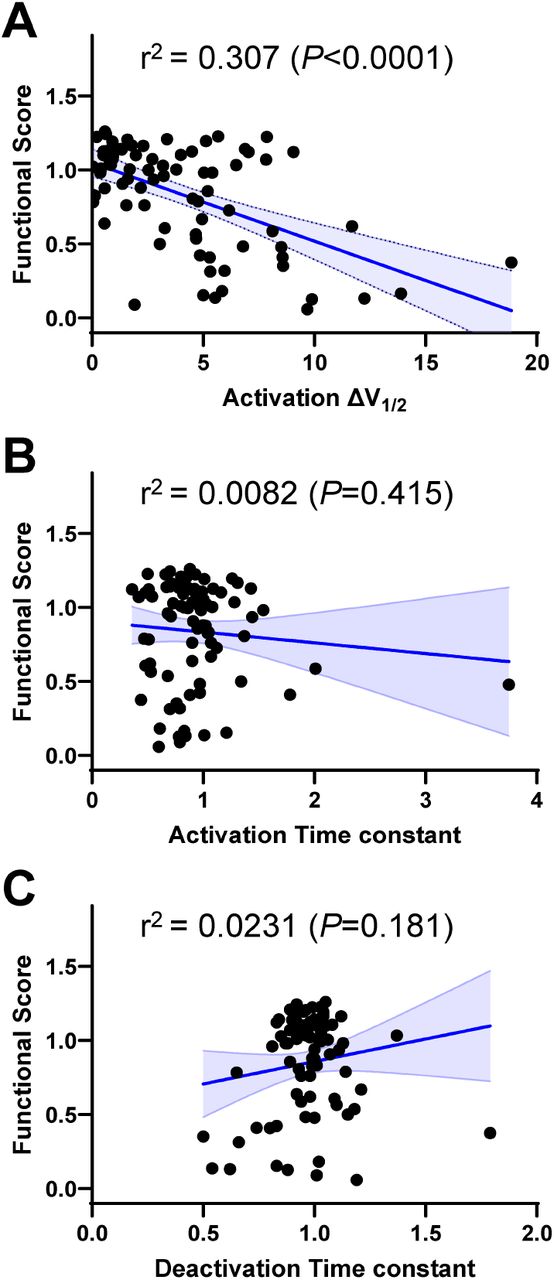
    Correlation of biophysical properties with functional scores from a KCNE1 deep mutation scan. ( A ) Plot of differences in activation V½ (ΔV½ in mV) measured in cells co-expressing WT KCNQ1 with KCNE1 variants (homozygous state) compared with the Functional Score reported for each variant determined by a cell fitness assay. ( B ) Plot of differences in activation time constants measured in cells co-expressing WT KCNQ1 with KCNE1 variants (homozygous state) compared with the reported Functional Score. ( C ) Plot of differences in deactivation time constants measured in cells co-expressing WT KCNQ1 with KCNE1 variants (homozygous state) compared with the reported Functional Score.

    Journal: bioRxiv

    Article Title: Functional profiling of KCNE1 variants informs population carrier frequency of Jervell and Lange-Nielsen syndrome type 2

    doi: 10.1101/2025.03.28.646046

    Figure Lengend Snippet: Correlation of biophysical properties with functional scores from a KCNE1 deep mutation scan. ( A ) Plot of differences in activation V½ (ΔV½ in mV) measured in cells co-expressing WT KCNQ1 with KCNE1 variants (homozygous state) compared with the Functional Score reported for each variant determined by a cell fitness assay. ( B ) Plot of differences in activation time constants measured in cells co-expressing WT KCNQ1 with KCNE1 variants (homozygous state) compared with the reported Functional Score. ( C ) Plot of differences in deactivation time constants measured in cells co-expressing WT KCNQ1 with KCNE1 variants (homozygous state) compared with the reported Functional Score.

    Article Snippet: Full length cDNA encoding WT KCNQ1 (GenBank accession number AF000571 ) was engineered in the mammalian expression vector pIRES-CyOFP1 (pIRES-CyOFP1-KCNQ1, AddGene #173162).

    Techniques: Functional Assay, Mutagenesis, Activation Assay, Expressing, Variant Assay